



One User, Many States of Mind
Every digital user journey is dynamic. A visitor doesn’t behave the same way throughout their session. They arrive with different goals, fluctuate in attention, shift motivations, and toggle between modes of engagement.
Despite this, most websites treat users as static. Personas are assigned, flows are linear, and design decisions are made for a single mindset. This limits both experience quality and business performance. In a digital environment defined by choice and distraction, what’s needed is responsive design that also adapts to cognitive shifts. Interfaces must be designed to recognize and respond to changes in user behavior. They must be able to guide users toward better decisions.
This article explores how designing for both passive and active processing helps close critical gaps in the conversion funnel, supports better decision-making, and improves conversion outcomes.
Understanding the Two Modes: Passive and Active Processing
Users process information in different ways depending on context, emotion, and intent.
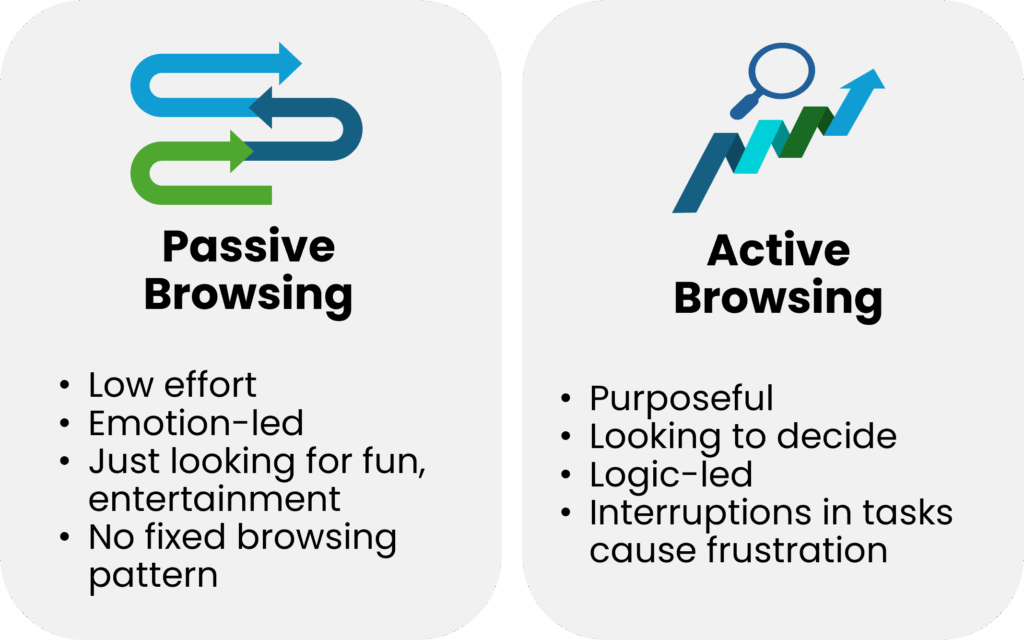
Importantly, users do not stay locked in one mode. A session might start with passive browsing. Interest may grow, and the user shifts into a decision-making mindset. The reverse is also common. Friction or uncertainty can turn a decisive user into one who disengages or starts exploring again without purpose.
Designing for just one of these modes creates blind spots. It works well for some visitors and moments but leaves others unsupported.
Mapping Processing Modes to the Conversion Funnel
The conversion funnel outlines the stages a user goes through before making a decision: Awareness, Interest, Consideration, Intent, and Action.(Strong, E. K.,1925). Each stage represents both a goal and a potential drop-off point. Understanding whether users are in a passive or active mindset helps clarify where the funnel is leaking and why.
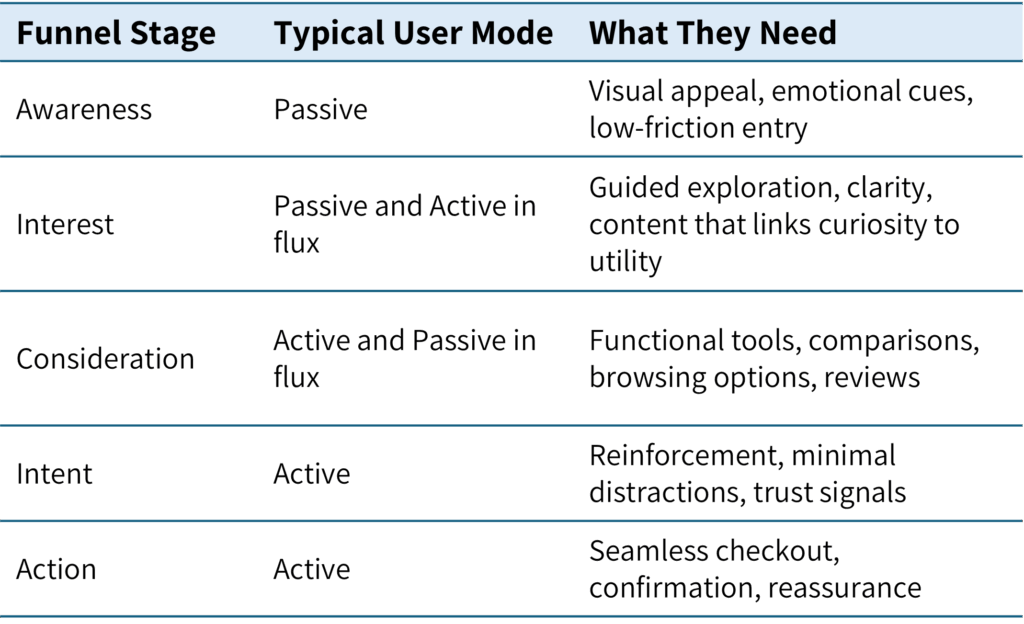
If the website only supports passive engagement, users who are ready to decide may become frustrated. If it only serves active users, those who are still exploring may drop off before forming an intention. To close these gaps, websites need to detect the user’s current mindset and guide them toward the next step.
Designing for Both Modes to Improve Funnel Performance
Each mode demands different types of design interventions.
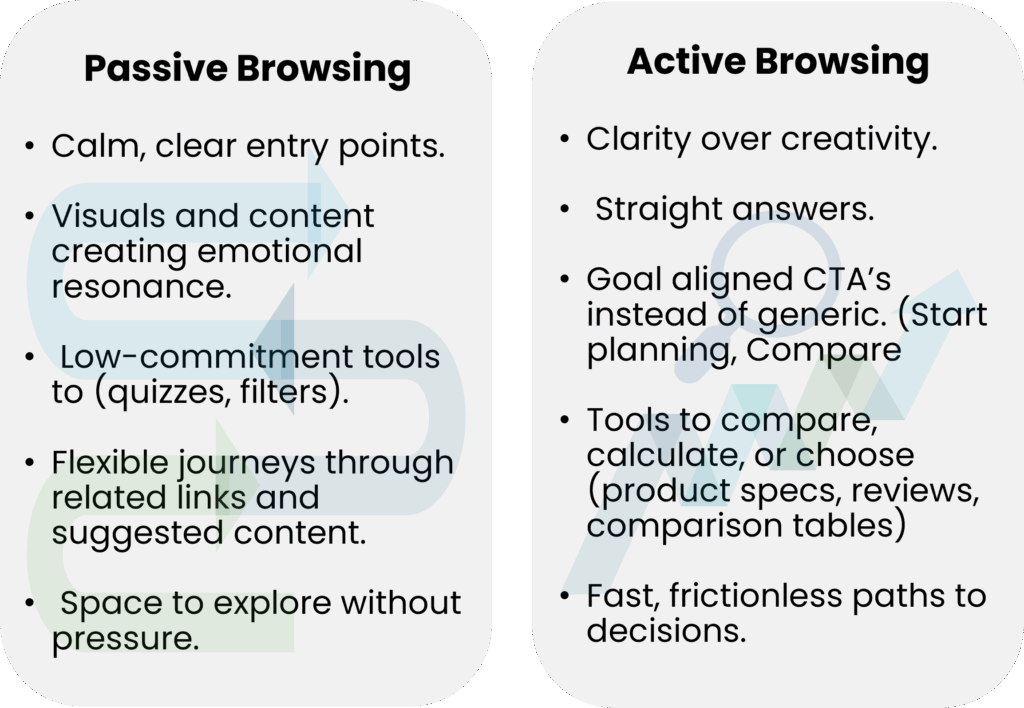
Together, these two approaches reduce drop-offs. They also ensure that the website remains useful at each stage of the user journey.
Helping Users Shift from Browsing to Deciding
Websites that support both modes can do more than reflect user behavior. They can guide it.
Consider a visitor browsing a travel platform. They begin by viewing pictures and reading short descriptions of destinations. Their interest grows, and they see a button that reads “Plan Your Trip.” This prompt leads them to pricing tools and filtering options. The interface makes it easy for them to move from passive discovery to active planning.
This kind of mode-sensitive design encourages users to move forward in the funnel. It encourages users to convert to further action during the Interest and Consideration stages. These are points where intent is forming but not yet committed. Friction or distraction here often leads to abandonment.
Offering clear paths forward allows users to progress more confidently.
Matching Behavioral Design to Brand Objectives
Different brands and industries have different goals. A media site may want users to stay longer. A finance tool might prioritize completion of a calculator or form. A retail business may focus on encouraging purchase decisions while still supporting exploration.
Behavioral design should support the primary goal of the brand.
- E-commerce wants decisions, but also discovery. Encourage comparison, upsell paths, and bundles.
- Media platforms want longer sessions. Prioritize passive loops, infinite scrolls, and related content.
- Travel websites want to inspire planning. Blend exploration (photos, itineraries) with tools for decision-making (price calendars, filters).
- Healthcare or finance, want to appear credible and reliable sources for complex topics. Tiered presentation of information which guides users to slowly delve deeper and offer related actionable content.
When design reflects brand goals and user mindsets together, both user experience and business impact improve.
A Real Example: Changing a Button to Match User Mode
On a laptop retail website, the product pages included a CTA labeled “Learn More.” The assumption was that users wanted to read additional information. But most visitors were already in a decision-making mindset. They had compared brands or features before arriving and were ready to act.
By changing the button to “Compare,” the design shifted to match user intent. This small change led to a noticeable increase in click-through rates and time spent on product pages. Users explored multiple options and reported higher satisfaction. They had the tools they needed at the right moment.
This example shows how aligning interface language and function with user mode improves outcomes. It keeps users moving in the funnel rather than stalling.

From Awareness to Action: A Shift in Design Thinking
Traditional UX methods focus on ease of use and visual appeal. These remain important. But behavior-based design goes further. It asks how the site can support the way users think and act as they move from awareness to action.
This begins with mapping likely behaviors at each funnel stage. The next step is to introduce small nudges and design elements that encourage progress. A banner might suggest a planning tool. A scroll behavior might trigger a comparison interface. A hovering action might surface a quick-view CTA.
These cues work best when subtle and well-timed. They do not push users before they are ready. Instead, they offer tools that are helpful in that moment.
Conclusion: Designing for a Moving Target
Digital users are not static personas. They are shifting processors of information. The same visitor can be distracted in one session and highly goal-oriented in the next. Sometimes, they shift modes within minutes.
Websites that understand these shifts can better serve their users. More importantly, they can guide those users toward higher-value actions in ways that feel natural and satisfying.
Designing for passive and active browsing modes allows brands to close the gaps in the conversion funnel. It creates journeys that are more responsive to human behavior. And it transforms digital spaces from neutral containers of information into powerful tools for decision-making and growth.
Websites improve by recognizing user modes and responding to them intelligently. They become easier to use, more trustworthy, and more effective. Clear alignment with business goals helps transform them into high-performance environments that support both user needs and brand success.