

Digital design research uncovers market needs, generates and validates product concepts, and drives the creation of user-centered digital solutions – blending strategy, creativity, and behavioral insights at every step.
Market Opportunity Identification
We identify market opportunities by combining trend scans, consumer need mapping, competitor analysis, and whitespace exploration. This structured process reveals unmet needs and market potential, helping innovators move beyond their initial ideas and develop a portfolio of viable product concepts aligned with real market demand.
Concept Generation & Evaluation
We use a range of creative and analytical techniques to generate dozens of product ideas around a defined opportunity. Each concept is rigorously screened through structured evaluation methods, narrowing the field to a handful of high-potential, feasible ideas ready for further development and testing.
Digital Product Brief
We translate selected concepts into strategic product briefs that articulate the business case, product vision, user value, and success metrics. These briefs guide senior leaders and product teams, ensuring alignment, clarity, and a sharp strategic focus throughout the product development lifecycle.
Rapid Prototyping and Testing
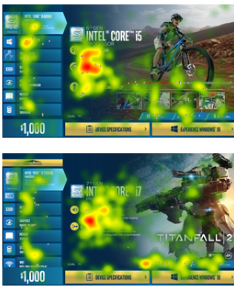
We rapidly prototype digital concepts to evaluate product design, user value, and benefits. Through user testing, eye-tracking, and A/B comparisons, we refine features, enhance utility, and create seamless, intuitive experiences by eliminating friction and hesitation.
Digital Innovation Labs
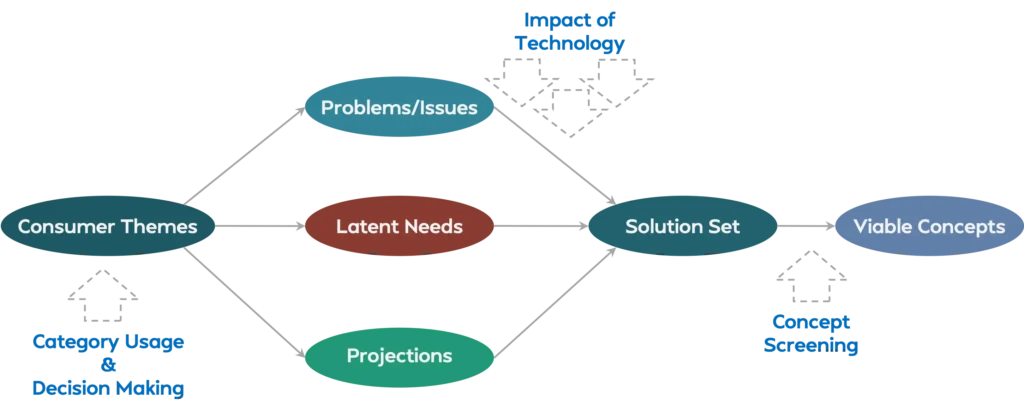
The Innovation Lab is a discovery engine for market-driven innovation. We identify untapped opportunities, map consumer problems, and generate solution concepts. Through a structured evaluation process, we prioritize ideas with the highest potential, setting the stage for meaningful, feasible, and desirable digital innovation.
The objective of the Innovation Lab is to identify new product and service concepts that add real value to the consumers. We follow a problem-based ideation process to generate useful and viable ideas that are practical and implementable.
Target Markets to Address, Differentiation Strategy, Competitive Positioning, Information Content, Tools and Products to Offer, And Strategic Roadmap.
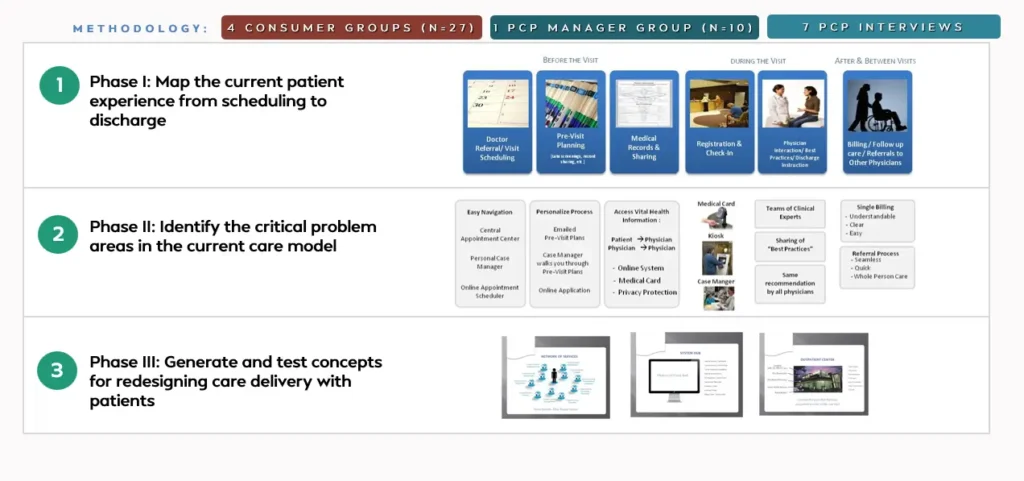
The research follows a three-phase process: Identify Problem Set, Develop Opportunity Set, and Generate Concept Set.
The ideas and concepts generated over several groups are assembled and a final edited list is created for preliminary screening based on criteria developed in consultation with the client. An “Innovation Portfolio” of the best ideas is presented to the client as the final deliverable.
A Health System wanted to design a consumer app to help patients find physicians. The physician finder tool/app must offer four key benefits:


Setup:
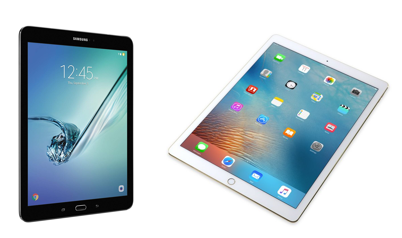
After the initial briefing on the semi-functional prototype, the participant wears eye-tracking glasses to do a search on an 8-inch tablet (iPad or Android).
In this session, participants are directed to do different tasks varying in complexity.
Participants are told that they must complete the task using the app, plus they can ask for additional “pages” of information from the research assistant in the room. The research assistant will provide additional information requested on pre-designed paper cards or manually sketched pages.
The Eye Tracking recording of the sessions is replayed. The researcher conducts a frame-by-frame interview of both the self-browsing activity and the card activity.
The focus of the interview is on:
1.TASK COMPLEXITY
2.TASK FRAMING
3.RELEVANCE OF INFORMATION
4.ADEQUACY OF INFORMATION PROVIDED
5.UNDERSTANDING OF TERMS
6.UNDERSTANDING OF DIFFERENCES IN TILES
7.FILTER CATEGORIES
8.IMPACT OF LISTS SHOWN ON THE DECISION PROCESS
9.MISSING ELEMENTS
Finally, the researcher focuses the discussions on the overall utility of the tool, what express needs and motives it satisfies, how the tool is likely to be used, what emotional and psychological gratifications it provides, etc.
The researcher also tries to understand how the tool impacts the brand’s image.

Android or iOS tablet tethered to a remote monitor wirelessly or wired for observing the session in real time.
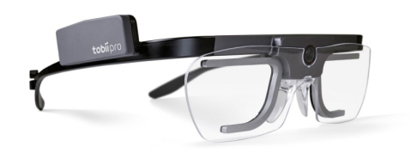
Mobile eye tracker with recorder and remote viewer
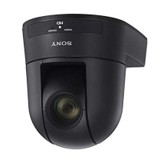
Multiple ceiling mounted cameras and overhead cameras to capture card activity and room
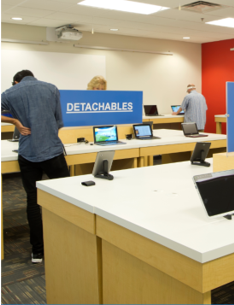
Assess effectiveness of iPOS on key metrics:
Explore potential areas of improvement in iPOS to further drive its key metrics.
We’d love to hear from you!
Please enter your contact details if you want to know how we can help your business through strategic research, UX/UI design, or brand innovation.